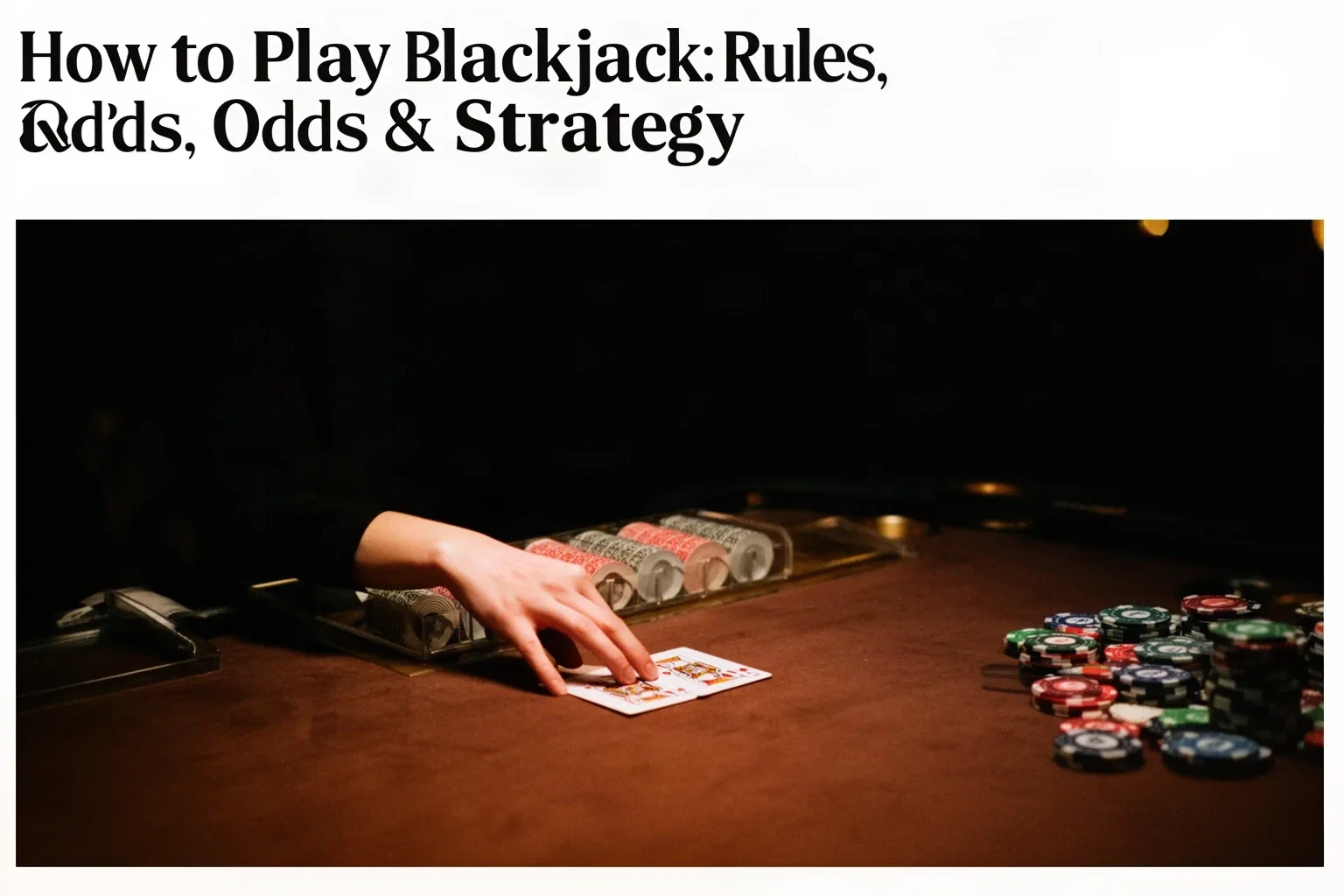
If you’ve ever watched a dealer pull cards and wondered whether you could beat the house, you’re in the right place. Blackjack is a card game where you compete directly against the dealer, aiming to hit a hand value of 21 or as close as possible without going over. The blend of simple arithmetic and strategic decision‑making makes it a favourite for beginners and seasoned players alike.
How to Play Blackjack
A standard blackjack shoe contains anywhere from one to eight decks of 52 cards. Card values are straightforward: numbered cards count at face value, tens and picture cards (Jack, Queen, King) are worth ten, and an ace can be counted as either one or eleven, whichever benefits the hand. The dealer deals two cards to each player and two to themselves, typically one face‑up and one face‑down.
Your first decision comes after the initial deal. You can hit (take another card), stand (keep your current total), double down (double your bet and receive exactly one more card), or split if your first two cards are a pair. Some tables also offer surrender (forfeit half your bet) or the option to take insurance when the dealer shows an ace. The goal is to end with a higher total than the dealer without exceeding 21.
When you stand, the dealer reveals their hidden card and must draw according to the house rules – most commonly hitting until reaching 17 or higher. If the dealer busts (exceeds 21), all remaining players win. If both you and the dealer end with the same total, it is a “push” and your bet is returned.
Odds, House Edge and RTP
The house edge is the built‑in statistical advantage the casino holds over the player. For a typical casino game that uses four to eight decks, dealer stands on a soft 17, allows doubling after a split and does not offer surrender, the edge sits at roughly 0.50 %. That translates to a return‑to‑player (RTP) of about 99.50 % over the long run.
Small rule changes can shift those numbers noticeably. If the dealer hits a soft 17, the edge climbs to around 0.60 %. Allowing early surrender cuts the edge to near 0.30 %. Conversely, prohibiting double after split or limiting the number of splits pushes the edge above 1 %.
Because RTP is an average, short‑term results can swing wildly – you might win big or lose quickly. Understanding the exact rules of the table you sit at is essential; the same game can have a different house edge depending on those details.
Basic Strategy Chart
Basic strategy is a mathematically derived set of decisions that minimise the house edge. The chart is organised by your hand total (rows) and the dealer’s up‑card (columns). Below is a condensed version you can memorise or keep at the side of the table.
- Never hit a hard 12‑16 when the dealer shows 2‑6 – stand instead.
- Always hit hard 12‑16 when the dealer shows 7 or higher.
- Always stand on hard 17‑21.
- Double down on 11 against any dealer up‑card; on 10 if dealer shows 2‑9.
- Double down on 9 only when dealer shows 3‑6.
- Split aces and eights always; never split fours, fives or tens.
- Split twos, threes, sixes and sevens when dealer shows 2‑7.
When you use the chart, you are playing at the optimal level for that rule set, which brings the effective house edge down to the 0.20‑0.30 % range. For a full printable version, see the Blackjack Basic Strategy Explained article.
Common Mistakes to Avoid
Even seasoned players slip into habits that erode their edge. Here are the most frequent errors:
- Taking insurance – the payout of 2:1 is a losing bet in the long run.
- Never splitting pairs that should be split (e.g., twos or threes against a weak dealer).
- Always hitting soft 17 – the correct play is to stand when the dealer stands on soft 17.
- Chasing losses by increasing bet size – this does not change the underlying odds.
- Ignoring the basic‑strategy chart and playing on gut feeling.
Where to Play Blackjack Online
Reputable online casinos host both software‑based tables and live‑dealer streams. Look for licences from respected regulators such as the UK Gambling Commission, Malta Gaming Authority or the New Jersey Division of Gaming Enforcement, depending on where you reside.
If you enjoy the authentic feel of a real dealer, the Blackjack guide page lists operators that provide live‑dealer options. New players may also benefit from generous Casino bonuses, but always read the wagering terms before committing.
For a broader view of the market, our Casino reviews page compares the top platforms on factors like game variety, payout speed and player support.
FAQ
What bankroll should I start with? A common recommendation is to have at least 50‑100 times the minimum bet you plan to use, giving you the flexibility to survive normal variance.
Is blackjack legal everywhere? Legality varies. In the United Kingdom, you must be 18 or older and play at a licence‑holder regulated by the UK Gambling Commission. In many European countries, the Malta Gaming Authority is a common regulator. In the United States, each state sets its own age – often 21 – and regulatory body, such as the New Jersey Division of Gaming Enforcement.
How does the house make money? The house edge is built into the payout rules – for example, a natural blackjack pays 3:2 instead of even money, and the dealer’s advantage on busting hands. Our article How Casinos Make Money: The House Edge Explained dives deeper.
Where can I get help if gambling becomes a problem? Reach out to responsible‑gambling organisations such as BeGambleAware, GamCare or Gamblers Anonymous. They offer free advice and support.
Play responsibly (18+ or 19+ depending on jurisdiction)
If you feel you may have a gambling problem, please contact BeGambleAware, GamCare or Gamblers Anonymous for confidential help.