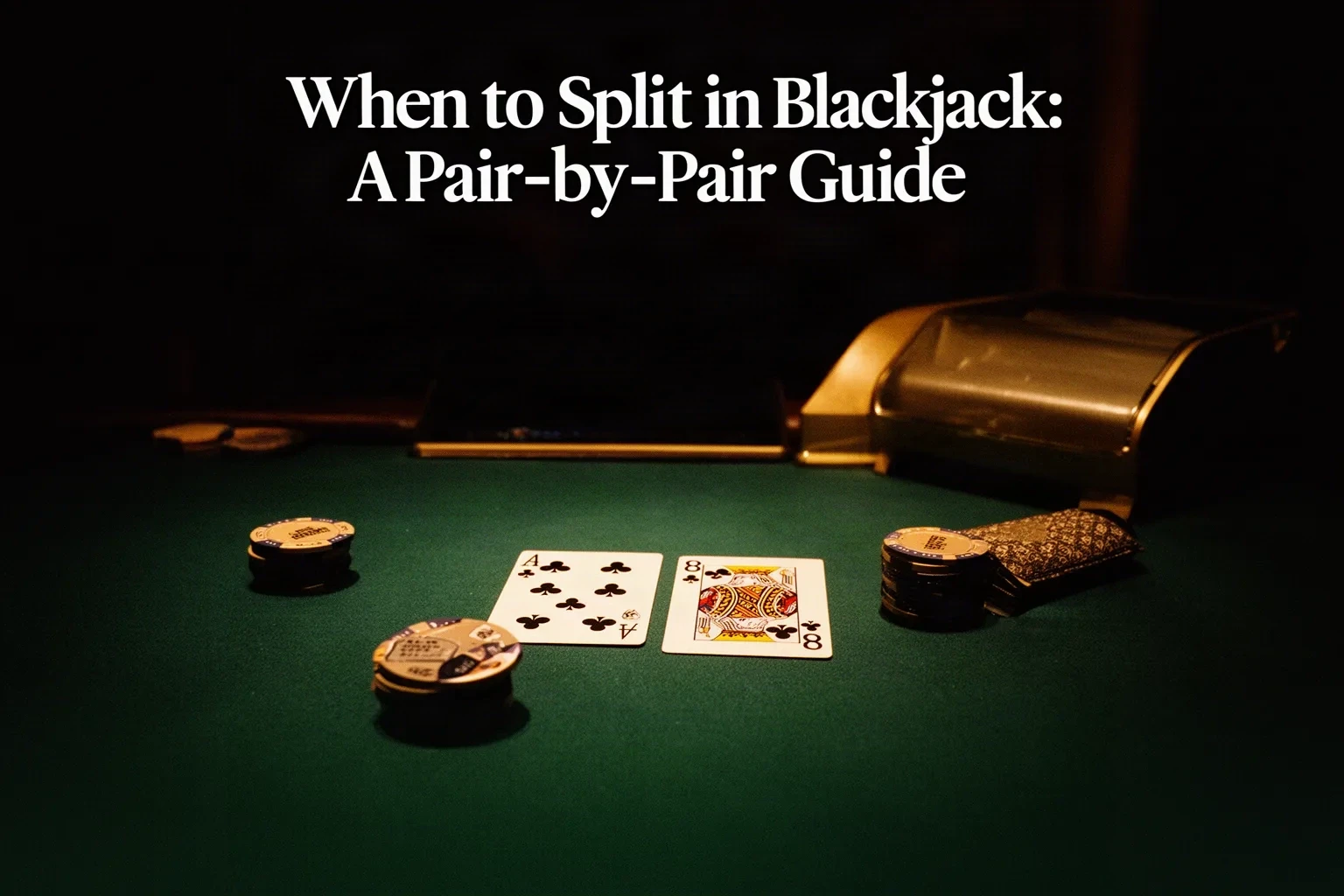
Blackjack split rules decide what you can do with a pair: whether you may split it, how many cards each new hand receives, and what a 21 pays afterwards. A split lets you take a pair, two eights for example, and play it as two separate hands, each with its own bet. The rules for doing it vary from table to table, and so does the money you put at risk.
How a split works at a real table
The house rules published by Hippodrome Casino give a clean example. You can split any pair there, including any two cards worth 10, such as a king and a jack. You place an additional bet equal to your original stake, and each split card is dealt a second card to form a new hand.
If you started with 10 chips on a pair of sevens, you now have 20 chips in play across two hands. Win one and lose the other and you break even. Lose both and you have lost 20 chips.
Aces get special treatment. Under the Hippodrome rules, split aces receive only one additional card each, and a 10 or picture card makes 21, not blackjack. Winning bets pay 1/1 and blackjack pays 3/2. On a 10 chip bet, a natural blackjack wins 15 chips, while a split ace and king that beats the dealer wins 10.
The blackjack rules issued by the Tasmanian Gaming Commission (Variation 02/15, effective 12 May 2015) say an ace with a card worth 10 is a blackjack, but that a blackjack cannot be obtained in any hand derived from splitting. The text we retrieved does not state what a split 21 pays.
What this means for you
Each split adds a bet equal to your original stake, and doubles, resplits and insurance can add more. Only split when you are comfortable with that extra money in play, and check how your table pays a 21 made after a split.
Blackjack split rules by jurisdiction
The Tasmanian rules describe a game played with four to eight decks dealt from a shoe. The table cloth must state that blackjack pays 3 to 2, that the dealer must stand on 17 and draw on 16, and that insurance pays 2 to 1. A player whose first two cards total less than 12 must draw until reaching 12 or more, subject to the doubling rule.
Treat that rulebook as an example rather than current law. It dates from 2015, we could not confirm it is still in force, and the copy we retrieved breaks off before the full splitting and settlement rules.
Split to Double Blackjack, a Galaxy Gaming variant, works very differently. Pennsylvania sets it out in 58 Pa. Code § 633b.26, a temporary provision effective 14 June 2025 and due to expire 14 June 2028. Washington's version comes from rules of play enclosed with a Washington State Gambling Commission approval letter dated January 2023. Both share this core:
- You cannot hit. Splitting and doubling are your only routes to extra cards.
- You may split any initial two cards, regardless of their values.
- You can double for between 1x and 4x your main Blackjack wager.
- Blackjack pays 2 to 1, and you must place an equal Blackjack or Bust wager alongside your main bet.
- If you surrender your first two cards, the main wager pushes and the Blackjack or Bust wager is lost.
The details differ. Washington's rules allow resplits of same value cards only, count 10s and face cards as the same value, and let operators set a resplit limit or none. Pennsylvania allows resplits of hands of identical value and refers doubling mechanics to its standard blackjack rules in § 633a.10.
The dealer rule differs too. Pennsylvania's layout must say the dealer draws to hard 17 and stands on all 18s, or similar approved language. Washington lets the operator choose whether the dealer hits or stands on soft 17 (a 17 that counts an ace as 11). Read the felt, or the game information panel online, before your first hand.
Odds and house edge: what the published numbers show
House edge is the share of each bet the casino expects to keep over the long run. RTP, or return to player, is the share it expects to pay back. None of the documents behind this guide publishes either figure for these games, so we give none rather than guess or import a number calculated for different rules. What the documents do publish are payout odds:
- Hippodrome Casino: winning bets pay 1/1, blackjack pays 3/2, and insurance of up to half your stake pays 2:1.
- Tasmania: blackjack pays 3 to 2, and insurance of up to half the original wager pays 2 to 1.
- Split to Double: winning main bets pay 1 to 1, blackjack pays 2 to 1, and insurance pays 2 to 1.
- Blackjack or Bust paytables: ace of spades with a black jack pays 20 or 25 to 1, suited blackjack 5 or 6 to 1, other blackjacks 2 to 1, and a dealer bust 1 to 1. In Washington, the 25 to 1 paytable is only available when the dealer stands on soft 17.
Payout odds tell you what a win pays, not how often you win. A 2 to 1 blackjack in Split to Double comes with no hitting and a compulsory side wager that loses whenever your hand busts, so the headline payout cannot tell you whether that game beats a 3 to 2 table.
What the rulebooks say about splitting strategy
Basic strategy is a chart of recommended plays for each hand against each dealer upcard (the one dealer card you can see). No source behind this guide contains one, so we do not give pair by pair advice here. Our separate guide, blackjack basic strategy explained, covers that topic. The rulebooks do give you the arithmetic of each starting pair:
- Two aces: under the Tasmanian card values an ace counts 11 unless that takes you over 21, so the pair plays as 12. Splitting gives two hands that each start on an ace, though at Hippodrome each gets only one more card.
- Two cards worth 10: the pair totals 20, one short of 21.
- Two eights: the pair totals 16, below the 17 that Tasmanian and Hippodrome dealers must reach.
- Small pairs such as twos or threes: the total is under 12, so at a Tasmanian table you would have to draw anyway.
The one piece of strategy guidance in the evidence comes from Washington's Split to Double rules of play. They describe players who cannot hit and instead look to split as often as possible to create double down opportunities. A hand holds at most three cards, and the rules state that the optional bonus wagers make no change to player strategy.
Combine the pair arithmetic with the dealer's upcard and your table's rules, then check a chart built for that exact rule set. Our complete blackjack guide puts splitting in context with every other decision.
Splitting mistakes that cost you money
- Assuming split aces can still make blackjack. At Hippodrome an ace and 10 after a split is 21 paid at 1/1, and the Tasmanian rules say a split hand cannot be a blackjack.
- Underestimating your stake. At Split to Double, 10 chips on each required wager is 20 chips. One split adds 10 and a 4x double on one hand adds 40, so that round already puts 70 chips at risk.
- Using a standard chart at Split to Double. With no hitting, it is a different game.
- Ignoring the posted rules. Resplit limits and the dealer's soft 17 rule vary by operator, as the Washington rules show.
Where to play blackjack with clearly posted split rules
This section is informational only. Play only with operators licensed in your own market, and check that split rules and payouts are displayed before you bet. In Tasmania, the rules above were issued by the Tasmanian Gaming Commission. In Pennsylvania, Split to Double layouts go to the Bureau of Gaming Operations for approval. In Washington State, the Gambling Commission approves games for commercial card rooms, while Tribal casinos need approval from their Tribal Gaming Agency, which seeks the Commission's concurrence.
You can read our licensed casino reviews or compare blackjack tables across casinos side by side. Some links on CasinoTips.io may be affiliate links.
Blackjack splitting FAQ
Can you split 10s and face cards? Hippodrome lets you split any two cards worth 10, and Washington's Split to Double rules treat 10s and face cards as the same value for resplits. The sources describe what is allowed, not whether it is a good play.
Does a split ace and a 10 count as blackjack? Not under the Hippodrome or Tasmanian rules. Hippodrome pays it at 1/1. The Tasmanian text we retrieved does not state the payout.
Can you resplit a pair? It depends on the table. Pennsylvania's Split to Double allows resplits of hands of identical value, and Washington operators can cap the number or leave it open.
Sources
- Blackjack Rules
- Rules of Blackjack
- 58 Pa. Code § 633b.26. Split to Double Blackjack.
- New rules boosting safety and consumer choice
- Split to Double Blackjack - GAMBLING COMMISSION - WA.gov
Play responsibly (18+, or 19+ to 21+ in some jurisdictions)
Only gamble if you meet the legal minimum age where you play, and stop if it no longer feels in control. Free, confidential support is available from BeGambleAware, GamCare and Gamblers Anonymous.