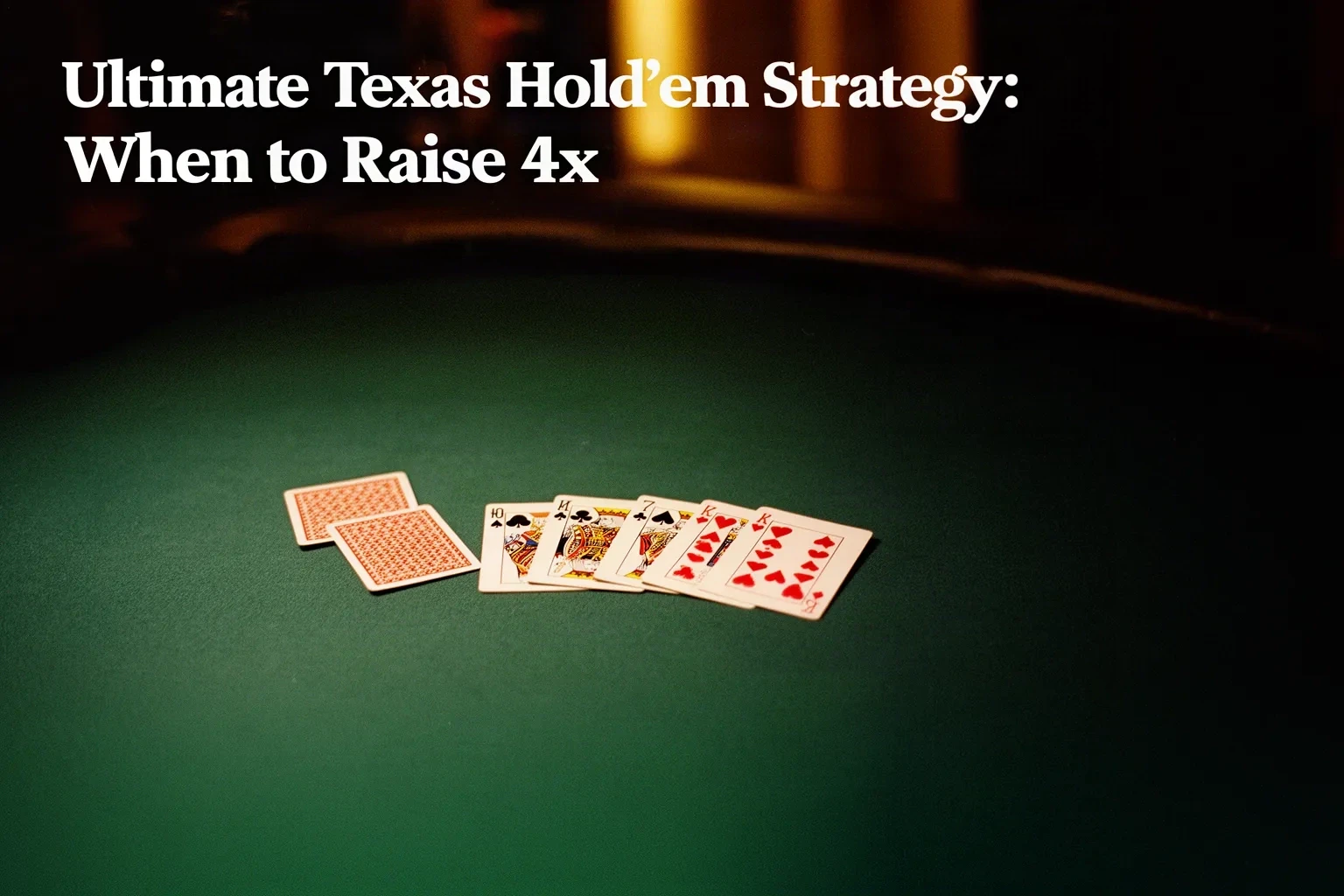
Ultimate Texas Hold'em, gives you one Play bet per hand. Ultimate Texas Holdem strategy comes down to when you make that bet and how big it is. Before the flop you can bet three or four times your Ante. On the flop you can bet two times. On the river you can bet one times, or fold. That ladder is set out in the California Bureau of Gambling Control's standard rules and in the game analysis published by the Wizard of Odds, a gambling mathematics site.
To compare this game with other tables, see our casino game guides.
How to play: Ante, Blind, Play and Trips
You play against the dealer, not other players, and your goal is a better five card poker hand than the dealer's. The California rules and the Wizard of Odds describe the same sequence.
- You place equal bets on the Ante and the Blind, and can add an optional Trips bet.
- You and the dealer each get two hole cards, private cards dealt face down.
- You either check or make a Play bet of three or four times your Ante.
- The dealer turns over three community cards, the shared cards everyone uses. This is the flop.
- If you checked, you can check again or make a Play bet of two times your Ante.
- The last two community cards, the turn and the river, are revealed.
- If you still have not bet, you must make a Play bet equal to your Ante or fold, losing both the Ante and the Blind.
- You and the dealer each make a best five card hand.
Once you make a Play bet, you cannot bet again or change it. The game uses standard poker hand rankings, from royal flush down to high card. For a refresher, see the poker hand rankings in our Texas Hold'em beginners guide.
Under the standard US rules published by the Wizard of Odds, player and dealer use any combination of their two hole cards and the five community cards. The Wizard reports that Auckland, New Zealand, requires both hole cards plus three community cards. The California document is inconsistent on this point, so in a California cardroom, ask staff which reading applies.
The dealer needs a pair to open
The dealer qualifies, or opens, with a pair or better. The Wizard of Odds scoring table and the California rules settle bets this way.
- If you win and the dealer opens, your Ante and Play bets pay 1 to 1.
- If you win and the dealer does not open, your Ante pushes, meaning it is returned, and your Play bet still pays 1 to 1.
- If the dealer wins, you lose the Ante, Blind and Play bets. If the dealer did not open, the Ante pushes instead.
- A tie pushes the Ante, Blind and Play bets.
The Blind pays only when you win with a straight or better: straight 1 to 1, flush 3 to 2, full house 3 to 1, four of a kind 10 to 1, straight flush 50 to 1 and royal flush 500 to 1. If you win with less than a straight, the Blind pushes.
Odds, RTP and house edge, stated exactly
The Wizard of Odds calculates a house edge of 2.185% per Ante bet under optimal strategy. That gives a return to player (RTP) of 97.815% of the Ante bet under optimal play. Both figures are measured against the Ante alone, not everything you put on the table.
Because you often raise, the Wizard puts the average total bet per hand at 4.152252 times the Ante. Dividing the edge by that total gives the element of risk, your expected loss against all money in play: 0.526%. The standard deviation, a measure of how much your results swing, is 4.94 relative to the Ante.
What this means for you
The 2.185% figure assumes perfect play. The simpler Wizard Strategy costs more, at 2.43% with a 0.58% element of risk. If your Ante is more than 1/500 of the table's maximum payout, a royal flush gets capped, and the Wizard says the edge rises 0.308% for every 100 the effective royal payout drops.
Trips pay tables vary widely
The Trips bet pays if your final hand is three of a kind or better, whatever the dealer holds. Under the California rules, a qualifying Trips bet pays even if you fold. The Wizard of Odds analyses four Shuffle Master pay tables, which match the four options the California document lists as UTH-01 to UTH-04. A return of minus 0.009018 means you lose 0.009018 units per unit bet, on average.
- Pay table 1 (full house 9 to 1, flush 7 to 1, straight 4 to 1): return minus 0.009018.
- Pay table 2 (full house 8 to 1, flush 6 to 1, straight 5 to 1): return minus 0.01904.
- Pay table 3 (full house 8 to 1, flush 7 to 1, straight 4 to 1): return minus 0.034979.
- Pay table 4 (four of a kind 20 to 1, full house 7 to 1, flush 6 to 1, straight 5 to 1): return minus 0.061808.
The worst table costs you several times what the best one does. Read the felt or the posted rules before you place the bet.
Why the pre-flop decision matters most
The California rules state the principle plainly: the earlier you bet, the more you can risk and win. The 3x or 4x size is only available before the flop, so a hand that waits can raise only 2x later.
The Wizard of Odds publishes the hands to raise 4x as a table, and that table was missing from the page copy we retrieved. For the pre-flop decision, use the Wizard of Odds table directly, listed in our sources.
Of the three base-game bets, Ante, Blind and Play, only the Play bet has a positive average return under optimal strategy.
Ultimate Texas Holdem strategy on the flop and river
If you checked before the flop, the Wizard Strategy says to raise 2x on the flop with any of these:
- Two pair or better.
- A hidden pair, except pocket deuces. A hidden pair is any pair that uses at least one of your hole cards.
- Four to a flush, including a hidden 10 or better of that suit.
If you checked twice, raise 1x on the river with a hidden pair or better, or when fewer than 21 dealer outs beat you. Otherwise fold. An out is a dealer hole card that would make you lose.
In the Wizard's worked example, 15 cards would pair the dealer and beat you, and 8 more, the four jacks and four queens, would outkick you. That makes 23 outs; cards that only produce a tie do not count. Because 23 is 21 or more, you fold. The Wizard calculator puts raising at minus 2.136364 units against minus 2 for folding.
Common mistakes that raise your cost
- Checking before the flop by default, giving up the larger raise the rules only allow at that stage.
- Folding on the river with a hidden pair, or when fewer than 21 dealer outs beat you.
- Posting a Trips bet without checking which pay table is in play.
- Betting an Ante larger than 1/500 of the maximum payout, which caps your royal flush.
Raise and fold errors push the base-game cost above the 2.185% optimal figure.
Rule variants differ by jurisdiction
The game you sit at may not match the standard rules. The California Bureau of Gambling Control document, marked Revised March 2015 and posted on the state Attorney General's website, has a seated player act as dealer, rotating around the table, with the house taking no part in the outcome. We have not confirmed whether a later revision exists, so check current rules with the cardroom.
Do not apply the Wizard's 2.185% and 0.526% figures to a California cardroom unqualified. They exclude collection fees, which cardrooms must explain in a Collection Table. They also ignore the California rule that payoffs are limited to the player-dealer's wager, with uncovered bets returned to players.
Nevada's gaming regulator publishes rules for Mini Ultimate Texas Hold'em, a different game with its own pay tables, and this strategy does not apply to it.
Where to play Ultimate Texas Hold'em
This guide is informational and recommends no operator. Play only at a casino licensed in your own market, and check its licence and the minimum age on the relevant regulator's website, since both vary by jurisdiction. Our licensed casino reviews are a starting point, and you can compare casinos by market and licence.
Ultimate Texas Hold'em FAQ
Is the Trips bet worth it? All four pay tables the Wizard analyses favour the house, from minus 0.009018 per unit on the best table to minus 0.061808 on the worst, so look for the 9 to 1 full house table if you play it.
What happens when the dealer does not qualify? Your Ante pushes, and your Play and Blind bets settle normally.
Sources
- Ultimate Texas Hold'Em
- OVERVIEW Mini Ultimate Texas Hold'em is a table game ...
- Ultimate Texas Hold'em Rules & Strategy
- Ultimate Texas Hold'em: the four-decision tree
- Subtitle 05 TABLE GAMES | Library of Maryland Regulations
Play responsibly (18+, or 19+ to 21+ in some jurisdictions)
Gambling is for adults only: the minimum age is 18+, or 19+ to 21+ in some jurisdictions, so check the legal age set by the regulator where you play. If gambling stops being fun, contact BeGambleAware, GamCare or Gamblers Anonymous.