Casino Holdem strategy, for the game usually written Casino Hold'em, comes down to one decision per hand: after the flop you call or fold. According to the combinatorial analysis published by the Wizard of Odds, an optimal player calls about 82% of the time and folds only the worst 18% of hands. Your long run cost also depends on the ante pay table and any side bets you add.
About the evidence
We could not obtain an official rules or pay table document from the game owner or any software provider. The figures below come from one undated independent analysis, so treat them as indicative and read the game rules wherever you play before you bet.
Casino gambling is for adults only, and the legal minimum age varies by jurisdiction, so check the rules where you live. For other games, browse our full library of casino game guides.
How a hand of Casino Hold'em plays out
Casino Hold'em is a poker variation similar to Texas Hold'em, played with a standard 52 card deck against the dealer rather than other players. A live casino guide from Unibet describes the same basic flow, including a call bet of double the ante, but does not cover dealer qualification or the pay table, so those details rest on the Wizard of Odds alone.
- You place an Ante bet. Some tables also offer optional side bets.
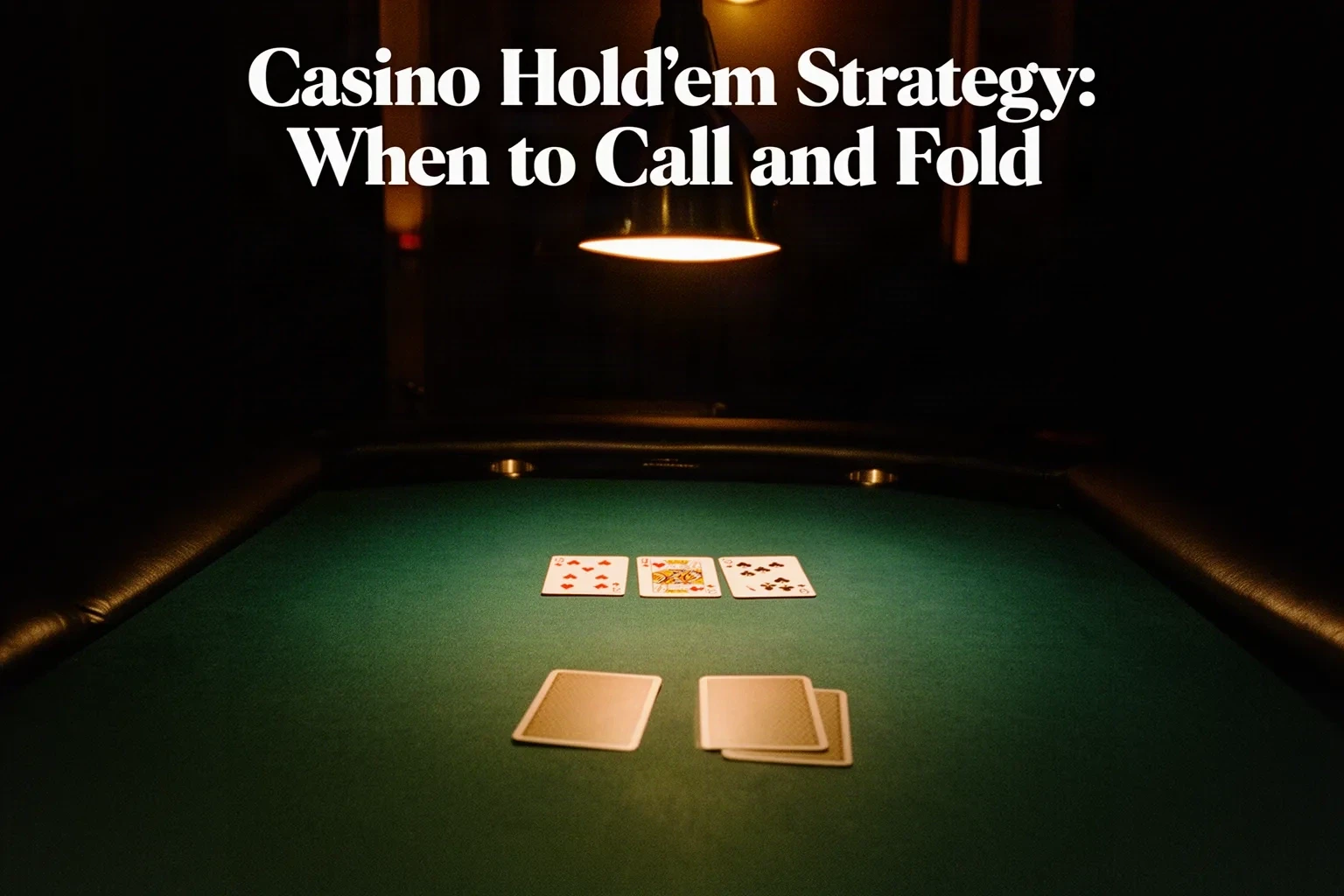
- You and the dealer each receive two hole cards, which are private, and three community cards, the flop, are dealt face up.
- If you fold, you lose your ante. If you call, you place a Call bet equal to twice your ante.
- Two more community cards follow and the dealer reveals both hole cards.
- Each side is scored on its best poker hand from its two hole cards and the five community cards.
The dealer needs a pair of fours or better to qualify, meaning to have a hand good enough to play. That rule shapes every result:
- The dealer does not qualify: your ante pays from the ante pay table and your Call bet pushes, so it is returned.
- The dealer qualifies and you win: your ante pays from the pay table and your Call bet pays 1 to 1.
- The dealer qualifies and beats you: you lose both bets.
- The dealer qualifies and you tie: both bets push.
Casino Hold 'Em Open uses the same rules, except your hole cards are dealt face up. For a refresher on which hand beats which, see poker hand rankings in our Texas Hold'em beginner guide.
Odds, house edge and RTP by ante pay table
The house edge is the average share of each bet the casino expects to keep over the long run. RTP, or return to player, is 100% minus the house edge. Both are long run averages, not a forecast for any session.
The Wizard of Odds lists four ante pay tables. All pay 3 to 1 on a full house, 2 to 1 on a flush and 1 to 1 on every other hand. They differ at the top: pay table 1 pays 20, 20 and 10 to 1 on a royal flush, straight flush and four of a kind. Pay table 2 pays 25, 25 and 12. Pay table 3 pays 100, 20 and 10. Pay table 4 pays 100, 49 and 17.
- Pay table 3, which the Wizard of Odds was told is the most frequently used: house edge 2.16%, RTP 97.84%.
- Pay table 2: house edge 1.96% or slightly less, RTP at least 98.04%.
- Pay table 1: house edge 2.40% or slightly less, RTP at least 97.60%.
- Pay table 4: house edge 0.35%, RTP 99.65% before a 10% commission on net session wins.
Only pay tables 3 and 4 were fully analysed. The figures for tables 1 and 2 assume you use the strategy optimal for table 3, and the source says the true edge is slightly less than or equal to them, which is why their RTP is shown as a minimum.
The analysis reports pay table 4 on Gamesys software titled "Casino Hold 'Em with Zero House Edge" and calls the label a misnomer, because players paid a 10% commission on any net win per session. A session ended after one hour with no bet or after 24 hours, whichever came first. We could not confirm whether that game is still offered.
What this means for you
Check the ante pay table in the game rules before your first hand. A royal flush at 100 to 1 with a straight flush at 20 to 1 marks pay table 3. Pay table 1, with 20 to 1 on both, carries the highest published edge of the four.
A simple calling rule follows the shape of optimal play
Call by default. Fold only when your two hole cards are unpaired, low compared with the flop, and give you little or no chance of a straight or a flush. That is how the Wizard of Odds describes the optimal player's folds.
The same source says there is no easy way to quantify full optimal strategy, so no simple guideline matches a computer on every borderline hand. The examples below are our own illustrations of the general rule, not verified optimal decisions:
- You hold 7 and 2 of different suits and the flop is King, Jack, 9 in three suits. Both cards sit below the flop with no flush or realistic straight draw, so the rule points to a fold.
- You hold the same 7 and 2, but the flop is 7, Queen, 4. You now have a pair, so the rule points to a call.
- You hold two hearts and the flop brings two more. You have four cards to a flush, so the rule points to a call.
Calling often follows from the qualification rule. If the dealer fails to qualify, your Call bet pushes and your ante is paid. A weak call only loses its extra two units when the dealer qualifies and beats you, while folding always loses your ante. For borderline spots, the Wizard of Odds points to a Casino Hold'em calculator at beatingbonuses.com.
Common mistakes that raise your cost
- Folding too often. An optimal player calls about 82% of the time, so folding every unpaired hand gives away antes.
- Playing the AA+ side bet without checking its edge. It pays on a pair of aces or better after the flop, with a reported house edge of 6.40% or 6.26% on two land casino pay tables and 2.97% on one found on Gamesys software, all above the 2.16% on ante pay table 3.
- Playing the progressive jackpot when the meter is low. Its fixed wins return less than half the amount bet. For a player betting alone, each $1,000 in the meter adds 6.02%, with break-even at $9,503.22, and sharing the jackpot lowers the return slightly.
- Confusing Real Time Gaming's Caribbean Hold 'Em with the original. The Wizard of Odds reports that it pays only 1 to 1 on the ante when the dealer does not qualify, a change it says is not disclosed in the game rules.
Where to play Casino Hold'em online
The undated Wizard of Odds page lists the game in countries including Ireland, Malta, South Africa, the Netherlands and Romania, and online at casinos using Playtech, Gamesys, Real Time Gaming, Net Gaming and Galewind software. We have not verified that list against current provider sources, so treat it as historical. Live dealer versions exist, as the Unibet guide shows.
Play only at operators licensed in your own jurisdiction, and check your local regulator rather than assuming one country's rules apply to you. In Great Britain, the Gambling Commission describes its job as ensuring gambling businesses follow the rules when promoting products and dealing with customers.
Whichever site you consider, read the ante pay table and side bet terms first. Our independent reviews of licensed casinos are a starting point, and you can compare casino table game ranges side by side.
Casino Holdem strategy FAQ
What is the Casino Hold'em house edge? It depends on the ante pay table. On pay table 3, reported as the most common, it is 2.16%. Pay table 1 is 2.40% or slightly less, pay table 2 is 1.96% or slightly less, and pay table 4 is 0.35% plus a 10% commission on net session wins.
What is the RTP of Casino Hold'em? Pay table 3 returns 97.84%. Pay table 1 returns at least 97.60%, pay table 2 at least 98.04%, and pay table 4 returns 99.65% before its commission.
When should you fold in Casino Hold'em? Fold two unpaired cards that are low compared with the flop and give you little or no chance of a straight or flush. Optimal play folds only about 18% of hands.
Keeping your play safe and under control
Even near optimal play leaves the house an edge, so set a budget and a time limit before you sit down. In Great Britain, the Gambling Commission safer gambling page lists the National Gambling Helpline on 0808 8020 133 for England and Scotland and the NHS Wales Helpline on 0808 2819 265, both free and open 24 hours a day, 7 days a week. BeGambleAware, GamCare and Gamblers Anonymous also offer help. Elsewhere, your local regulator can point you to services.
Sources
Play responsibly (18+, or 19+ to 21+ in some jurisdictions)
Gambling is only for adults over the legal gambling age in your jurisdiction (18+, or 19+ to 21+ in some places). If gambling stops being fun, contact BeGambleAware, GamCare or Gamblers Anonymous, or in England and Scotland call the National Gambling Helpline on 0808 8020 133.