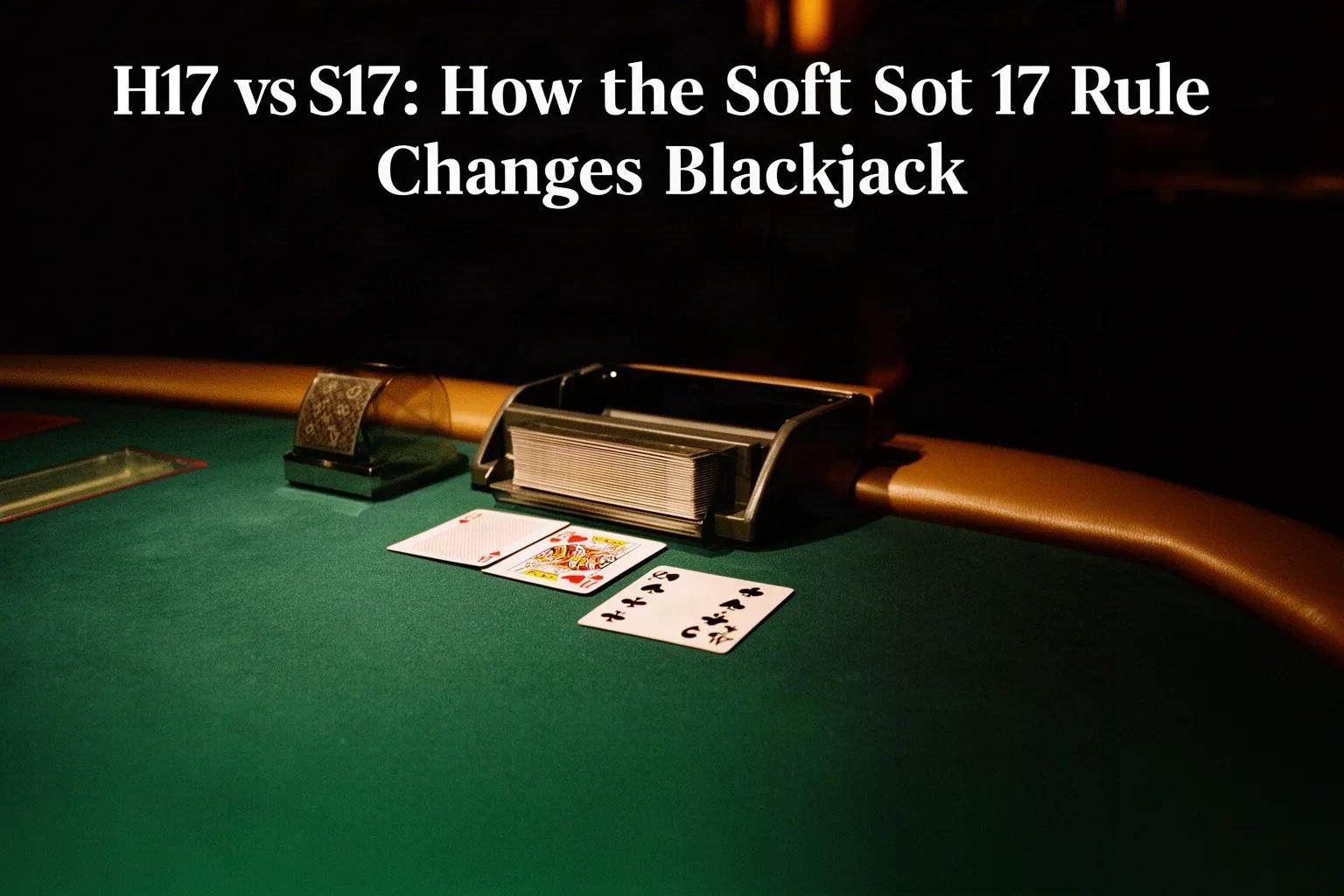
Before you put a chip down at a blackjack table, look for one short line printed on the felt. The H17 vs S17 rule tells you what the dealer does with a soft 17, and it changes how you should play a handful of hands.
A soft 17 is a total of 17 that counts an ace as 11, such as an ace and a six. Because that ace can drop to a value of 1, the hand cannot bust on the next card. The casino therefore has to decide in advance whether the dealer draws again or stops there.
H17 means the dealer must hit soft 17. S17 means the dealer stands on it. This guide covers the rule itself, what it means for the maths, the three strategy hands it affects and the mistakes players make at both kinds of table. If you are new to the game, start with our complete blackjack guide. You can also browse our casino game guides for other table games.
How the dealer plays a soft 17 under each rule
The cleanest way to see the rule in action is in an official game filing. The Nevada Gaming Control Board publishes the rules for Bahamas Bonus Blackjack, and it walks through a hand step by step.
You place your main wager, then the dealer gives each player two cards and takes one card face up and one face down. If the dealer's upcard is an ace or a ten-value card, the dealer peeks for blackjack. If nobody has blackjack, you act on your hand: hit, stand, double, split or surrender, depending on what the table allows.
Once every player has finished, the dealer reveals the hidden card. According to the filing, the dealer then "hits as long as the Blackjack total is 16 or less or if the hand is a soft 17." That is H17 in its plainest form. The same document lists an alternative configuration in which the dealer stands on soft 17, which is S17.
One caveat: Bahamas Bonus Blackjack is a variant, not standard blackjack. It uses five, six or eight 48-card decks with the tens removed, and it allows unusually liberal doubling. Treat it as an example of how the soft 17 rule is written and configured, not as a picture of a typical table.
How to check the rule in seconds
Blackjack Apprenticeship says the felt will read "Dealer must draw to 16 and stand on all 17s" at an S17 table, or "Dealer must Hit Soft 17" at an H17 table. Online, the same wording usually sits in the game's help or rules screen.
Odds, house edge and what the numbers actually measure
The house edge is the average share of each bet the casino expects to keep over a very large number of hands. Return to player, or RTP, is the same idea flipped round: 100% minus the house edge. Both are long-run averages. Neither tells you what will happen in your next session, which can swing a long way either side.
The soft 17 rule is one of the inputs that moves these numbers. A Monte Carlo study catalogued by the US National Library of Medicine models blackjack across 480 rule configurations, running each over 1,000,000 simulated hands with perfect basic strategy. Dealer soft 17 (S17 or H17) is one variable, alongside deck count (one, two, four, six or eight decks), double after split, late surrender, a 3:2 or 6:5 blackjack payout, resplitting aces and doubling restrictions.
I want to be straight with you here. The catalogue entry describes the simulation and its downloadable data, but it does not print per configuration results on the page. I have not checked figures against the raw data file, so this guide does not quote a house edge or RTP for either rule. A number I cannot verify is worse than no number, because you might make real decisions with it.
What the study's design does show is useful on its own. Soft 17 sits in a list of rules that researchers treat as worth isolating, and payout and doubling rules sit right beside it. That is a strong hint that you should weigh the whole table, not one line.
Rules travel in packages, not alone
The Nevada filing is a good illustration of why you cannot judge a table on soft 17 alone. In its default H17 setup, you may double up to three times on a hand, for up to eight times your original wager. In the alternative S17 configuration, you may only double once per hand.
So switching the dealer rule in that game also switches a doubling rule. The sources do not say which version works out better for the player overall, and I will not guess. The practical lesson is simpler: when one rule changes, look for what else changed with it.
Read the whole ruleset, not just the soft 17 line.
Three hands where basic strategy changes
Basic strategy is the set of mathematically best decisions for every combination of your hand and the dealer's upcard, assuming you are not counting cards. It is usually printed as a basic strategy chart. Blackjack Apprenticeship notes that charts differ slightly, and says that 99% of the time the difference centres on whether the dealer hits or stands on soft 17.
According to Blackjack Apprenticeship, only a few hands are played differently between the two games:
- Ace and eight (a soft 19) against a dealer 6.
- A hard 11 against a dealer ace.
- Ace and seven (a soft 18) against a dealer 2.
These are borderline spots where the right play is close, so a small change in how the dealer finishes a hand is enough to tip the decision. I am not listing the exact play for each rule here, because the sources for this piece do not state them. Use a chart built for your specific rules instead.
The sensible approach is to learn one chart and match it to the tables you actually play. Blackjack Apprenticeship's own chart is built for H17 games. If you mostly play S17 tables, find a chart made for S17. For the full picture of how charts are built and read, see how blackjack basic strategy works.
Common mistakes at soft 17 tables
Most errors here are not about maths. They come from not looking.
- Sitting down without reading the felt or the online rules screen, so you never learn which rule applies.
- Using an S17 chart at an H17 table, or the reverse, and getting those three borderline hands wrong.
- Choosing a table on the soft 17 rule alone while ignoring the blackjack payout, the doubling limits or surrender.
- Assuming a variant game follows standard rules when it may remove cards or change doubling.
- Adding side bets without checking their paytables first.
That last point matters more than it looks. The Nevada filing lists Match Up, Match Down, TriLux Bonus and TriLux Super 3 as optional extra wagers, each paid from its own paytable. They are separate bets with their own odds, and nothing about the main game's soft 17 rule tells you how they perform.
Where to play blackjack with clear table rules
Only play at sites licensed in the jurisdiction where you live, and check what your local regulator allows before you sign up. Rules on legal status and licensing vary from country to country and sometimes within a country, so do not assume what applies in one place applies to you.
Whichever site you use, open the help or rules screen for each blackjack game before playing. Good operators state the soft 17 rule, the payout and the doubling limits clearly. Our independent casino reviews are a starting point for comparing sites, but the game's own rules screen is the final word on how that table plays.
Gambling is for adults only. The minimum age is 18 or 19 depending on where you live. If gambling stops being fun, BeGambleAware, GamCare and Gamblers Anonymous offer free, confidential support.
H17 vs S17 FAQ
What does H17 mean in blackjack?
H17 means the dealer must hit a soft 17, a 17 that counts an ace as 11. S17 means the dealer stands on it. The Nevada Bahamas Bonus Blackjack filing shows both, with H17 as the default and S17 as an alternative configuration.
How do I tell if the dealer hits soft 17?
Read the felt. Blackjack Apprenticeship says S17 tables read "Dealer must draw to 16 and stand on all 17s" and H17 tables read "Dealer must Hit Soft 17". Online, check the game's rules screen.
Does the soft 17 rule change basic strategy?
Yes, but only slightly. Blackjack Apprenticeship names three hands: ace and eight against a 6, hard 11 against an ace, and ace and seven against a 2. Use a chart matched to your table's rule.
Which version is more common?
Blackjack Apprenticeship describes H17 as by far the most common rule variation offered. That is the view of a commercial training site rather than official data, so check each table rather than assuming.
Does the soft 17 rule affect the house edge?
It is one of the variables modelled in the NLM-catalogued Monte Carlo study of 480 rule sets. This guide does not quote a figure because the results were not verified against the raw data.
Sources
- Blackjack Expected Value Under Variable Rule Sets: A Monte Carlo ...
- Bahamas Bonus Blackjack
- Why the differences in Basic Strategy?
Play responsibly (18+ or 19+ depending on jurisdiction)
18+ or 19+ depending on your jurisdiction. Gamble only what you can afford to lose; for free, confidential help contact BeGambleAware, GamCare or Gamblers Anonymous.